How Accurate Is the Test
If you’re here counting days, here’s the short version.
With the lab test we use, a negative result at 6 weeks after your exposure is conclusive. If you haven’t taken PEP, and you haven’t had another risk since, that’s the end of it. You don’t need to come back at 3 months.
That’s current Australian guidance, and it’s worth knowing why, because plenty of what you’ll read online still says 90 days.
Why you’ll read “3 months” everywhere
The 90-day rule is answering a different question.
Australia’s testing policy sets 12 weeks as a statistical safety margin that has to cover every kind of HIV test, including fingerprick rapid tests, where slower seroconversion has been seen. 1 It’s the envelope built around the slowest test in the room.
We don’t use a fingerprick test. You see a doctor, we talk it through properly, and Dorevitch Pathology takes a blood sample on site at Collins Street. It’s a laboratory 4th generation test, and your result comes back by SMS the next day. And the 2025 ASHM guidelines put it plainly: if you weren’t prescribed PEP, you don’t need further HIV testing beyond week 6. 2 The testing policy also allows a reference laboratory running 4th generation testing alongside nucleic acid testing to report the window as 6 weeks. 1
So for our test the answer is 6 weeks.
What’s happening before then
I’d rather give you the shape of it than a false precision.
The first 10 days or so: nothing to find. This is the eclipse period. 1 No test can see HIV this early, ours included. A negative result here tells you nothing about the exposure you’re worried about.
Around 2 to 4 weeks: most infections become detectable. The policy puts time to detection on a lab 4th generation test at generally 3 to 4 weeks. 1 Some show up sooner. A negative here is genuinely reassuring, but it isn’t the finish line.
At 6 weeks: conclusive. A negative lab 4th generation result at 6 weeks means you can stop testing. Australian guidance doesn’t ask you to come back. Rare outliers have been reported in the literature, 1 which is exactly why this holds only if you didn’t take PEP and haven’t had another risk since.
I know you want a percentage for day 21. I’m not going to invent one. The guidelines don’t publish a day-by-day accuracy curve, and the ones floating around online aren’t sourced to anything. What the guidelines give you is dates, so dates are what I’ll give you.
If you took PEP, the timing is different
PEP changes this and you need to know it.
Starting HIV medication early can push back when antibodies appear, so a 28-day course of PEP can delay seroconversion. 2 That’s why follow-up runs longer: testing at week 6, and again at week 12. 2
If you took PEP and someone told you 6 weeks was enough, come back at 12.
What the test actually is
A laboratory 4th generation test looks for two things at once: HIV antibodies (your body’s response to the virus) and p24 antigen (a protein from the virus itself, which turns up before antibodies do). Looking for both is what shortens the window.
Here’s the part that matters, and it’s why we changed. Not all “4th generation” tests perform alike. On the fingerprick rapid test evaluated in an Australian study, the p24 part picked up very few acute infections, 3 and the national testing policy notes that point-of-care tests need longer windows generally, and that many recent infections would be missed if they were used on their own in gay and bisexual men. 1 Run on serum in a laboratory, the same technology does what it’s meant to.
So you wait until the next day instead of half an hour. In exchange, your negative means something sooner, and it means it more firmly.
What if the test is reactive?
Any reactive screening result, from any test, needs confirming at a reference laboratory. 1 A reactive screen is not a diagnosis. We organise the confirmatory test and talk you through it. We don’t leave people hanging over a weekend.
Some things worth saying plainly
Your risk matters as much as your calendar. Not every exposure is the same. Condomless anal sex carries real risk. Oral sex is extremely low, low enough that ASHM declines to put a number on it, though it isn’t zero. 2 The numbers are on the HIV risk page.
If it’s been under 72 hours, testing isn’t the priority. PEP is. It can stop HIV taking hold, but the window is 72 hours and sooner is better. Go to a sexual health clinic or an emergency department today, or ring 1800 PEP NOW (1800 737 669). Don’t wait on a test result to decide.
If you get fever, rash, sore throat or swollen glands in the weeks after an exposure, don’t wait for the 6 weeks to tick over. Come in and say why.
An HIV test on its own isn’t a full screen. Here’s what STI tests to actually ask for. We can organise a full sexual health screen at the same visit, with results by SMS in 24 to 48 hours.
Booking
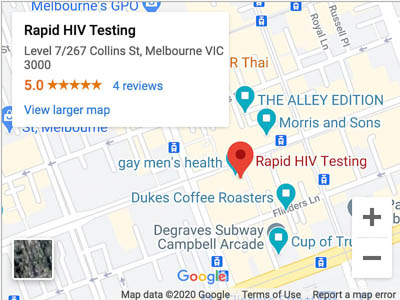
We’re in Melbourne’s CBD at Level 7/267 Collins St, with parking, trams, trains and buses nearby. You’ll see a doctor, have time to talk it through, and Dorevitch Pathology takes the sample on site. Your result comes by SMS the next day.
Phone 03 8575 6900 to book.
This information is general in nature and not a substitute for personalised medical advice. Speak to your doctor about your specific situation.
Dr George Forgan-Smith, GP, practising in Melbourne. AHPRA MED0001197864.
-
National HIV Testing Policy v1.6 (updated 2022), sections 2.1 and 2.3: https://ashm.org.au/wp-content/uploads/2024/03/ASHM_TestingPolicy_2020_HIV_V1-6_Web.pdf ↩︎ ↩︎ ↩︎ ↩︎ ↩︎ ↩︎ ↩︎
-
ASHM, Australian National Guidelines for Post-Exposure Prophylaxis after Non-Occupational and Occupational Exposure to HIV, Fourth Edition (2025): https://www.pep.guidelines.org.au/ ↩︎ ↩︎ ↩︎ ↩︎
-
Tan WS, Chow EPF, Fairley CK, et al. Evaluation of a Rapid Point of Care Test for Detecting Acute and Established HIV Infection. PLoS One. 2016. PMC4758636. ↩︎