How Does The HIV Test Work?
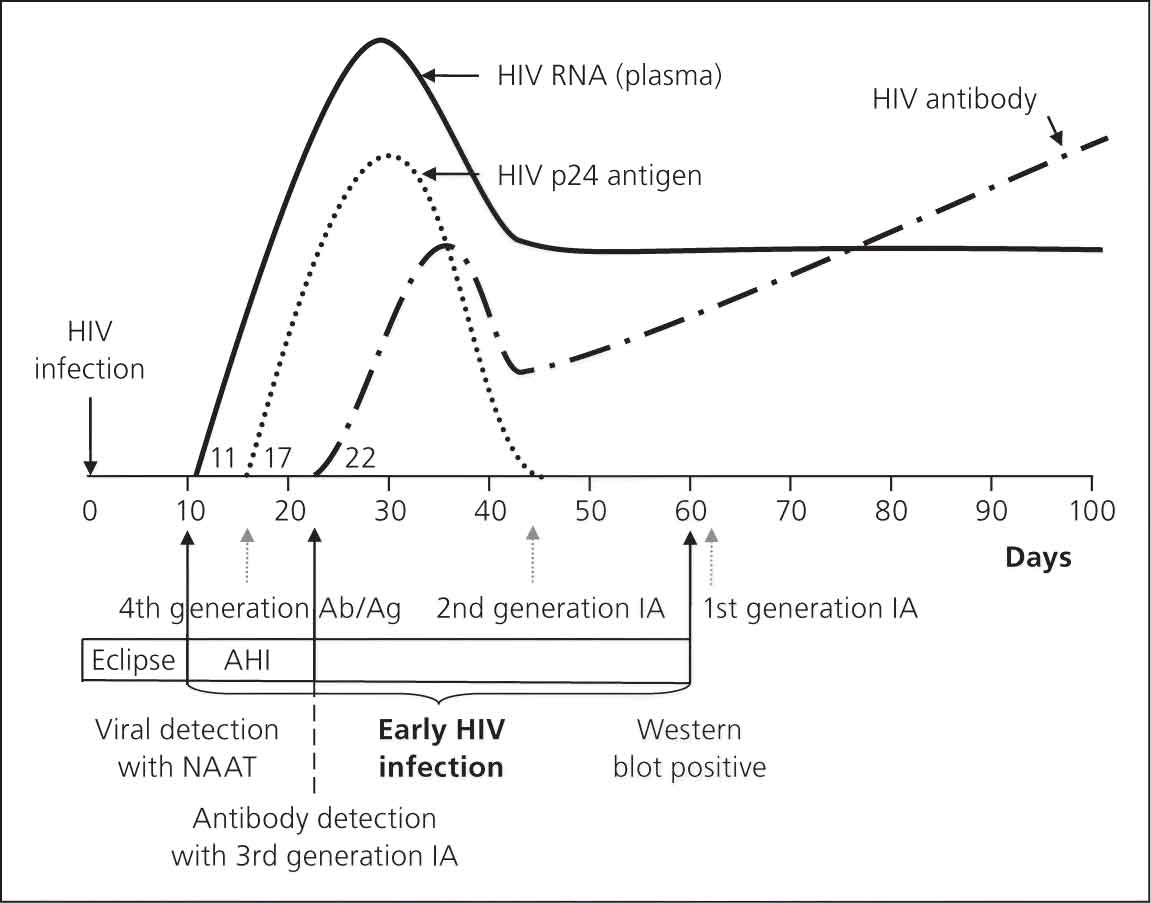
Screening tests for HIV don’t look for the virus directly. They look for your body’s reaction to it, and for one piece of the virus itself.
That’s the whole reason there’s a waiting period. There’s nothing wrong with the test. It’s that the thing being measured takes time to appear.
The window period, in one line
When someone acquires HIV, the body starts producing proteins in response. The test looks for those. But there’s a gap between infection and those proteins being detectable, and that gap is what we call the window period.
What are HIV antibodies?
With most infections, your body produces antibodies to fight back. HIV is no different.
Antibodies are reliable, but they’re slow. They’re the reason the older HIV tests needed a long window: you were waiting on your immune system, not on the laboratory.
What is p24?
P24 is a protein from the core of the virus itself.
It’s one of the first things that can be detected after infection, and it shows up before antibodies do. That’s the trick a 4th generation test pulls: by looking for p24 as well as antibodies, it catches infections earlier than an antibody-only test could.
The laboratory 4th generation test we use looks for both HIV antibodies and p24 antigen.
So what does a negative at 21 days mean?
This is the question I get asked most, so here’s the honest answer.
Roughly the first 10 days: nothing to find. This is the eclipse period. 1 No test sees HIV here.
Around 2 to 4 weeks: most infections become detectable. Australia’s testing policy puts time to detection on a laboratory 4th generation test at generally 3 to 4 weeks from infection. 1
So a negative at 21 days is genuinely reassuring, and it’s sitting right in the range where most infections are already showing up. It is not, on its own, the end of the story.
At 6 weeks: conclusive. If you haven’t taken PEP and haven’t had another risk since, a negative lab 4th generation result at 6 weeks means you can stop testing. Australian guidance doesn’t ask you to come back at 3 months. 2
I know you’d like a percentage for day 21 or day 28. The guidelines don’t publish a day-by-day accuracy curve, and the ones you’ll find online aren’t sourced to anything. What the guidelines give is dates, so that’s what I’ll give you. There’s more detail on how accurate the test is, including what changes if you took PEP.
Why the lab test, not a fingerprick
Not every “4th generation” test performs the same way.
On the fingerprick rapid test evaluated in an Australian study, the p24 part picked up very few acute infections. 3 The national testing policy notes that point-of-care tests need longer windows generally, and that many recent infections would be missed if they were used on their own in gay and bisexual men. 1
Run on serum in a laboratory, the same technology does what it’s designed to do. That’s why we take a blood sample here on site with Dorevitch Pathology and send your result by SMS the next day, rather than doing a fingerprick while you wait.
If it’s been less than 72 hours
Testing isn’t the priority yet. PEP is. It can stop HIV taking hold, but the window is 72 hours and sooner is better. Go to a sexual health clinic or an emergency department today, or ring 1800 PEP NOW (1800 737 669).
If you get fever, rash, sore throat or swollen glands in the weeks after an exposure, don’t wait for the window to close. Come in and say why.
Booking
Phone 03 8575 6900 and ask for an appointment with Dr George Forgan-Smith for an HIV test.
This information is general in nature and not a substitute for personalised medical advice. Speak to your doctor about your specific situation.
Dr George Forgan-Smith, GP, practising in Melbourne. AHPRA MED0001197864.
-
National HIV Testing Policy v1.6 (updated 2022), sections 2.1 and 2.3: https://ashm.org.au/wp-content/uploads/2024/03/ASHM_TestingPolicy_2020_HIV_V1-6_Web.pdf ↩︎ ↩︎ ↩︎
-
ASHM, Australian National Guidelines for Post-Exposure Prophylaxis after Non-Occupational and Occupational Exposure to HIV, Fourth Edition (2025): https://www.pep.guidelines.org.au/ ↩︎
-
Tan WS, Chow EPF, Fairley CK, et al. Evaluation of a Rapid Point of Care Test for Detecting Acute and Established HIV Infection. PLoS One. 2016. PMC4758636. ↩︎